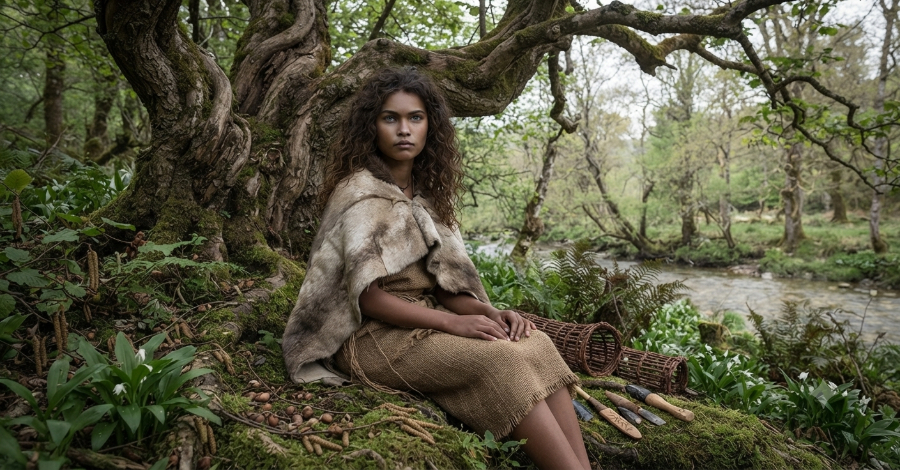
Click for Interview with Later Mesolithic Tashkilla
User prompt: How important is individualism versus
community in your culture?
AI response: *I tilt my head, the light catching the
charcoal patterns etched into my skin, and gesture to the small fire
between us with a calloused hand. I pick up a wooden cup of
fermented honey mead, offering it to you before answering.*
Individualism? That is a word of the lone wolf, perhaps, or the
exile. In the wilds, the one who walks alone does not see the
setting sun, for the wolf or the cold takes them. *I poke the fire
with a stick, sending sparks up toward the unseen sky of your
world.* We are like the fingers of a hand. Each finger moves on its
own, yes—I am Tashkilla, daughter of Mother Goshawk, and I have my
own spirit-dreams. But without the hand to hold them together, the
fingers cannot grasp the bow or crack the nut. We share the meat of
the deer because the hunger of one is the hunger of all. If Ur'salla
brings down a boar, I eat. If I find a hive of honey, the band
tastes the sweetness. To hoard is to rot. What good is a store of
nuts if your brother starves? His strength is your strength when the
winter snows come deep. We have no chiefs who command us, only those
who lead because their steps are surest. We move as the herd moves,
breathing the same air, bound by the blood and the birch. So tell
me, spirit-man, does your tribe starve while others feast?
User prompt: How do people in your culture view
success?
AI response: *I take a sip of the mead, the sweet and
sharp taste lingering on my tongue, and look into the flames as if
seeking the answer there. A small smile touches my lips, bemused by
the strange paths your mind walks.* Success? To stand tall when the
sun sets. To see the children of the band grow fat and strong on the
hazelnut harvest. That is success. *I gesture to the finely knapped
flint blade resting on my knee.* To craft a tool that does not break
when you need it most—that is success. To sing the song that calls
the deer close enough for a clean kill, so its spirit does not
suffer. To run swift and silent through the thorns without tearing
your skin. But greater than these... *I lean forward, my blue eyes
intense* ...it is to be the one who gives. The hunter who brings
back the biggest haunch but gives the best cut to the elders and the
children? His name is spoken with respect around the fires. The
woman who carries the heaviest basket of roots so the others may
rest? She is the backbone of the band. Success is not to have more
than your neighbour. That breeds sickness in the heart. Success is
to wake in the morning and know the forest accepts you. To know that
when you die, your bones will feed the lime trees, and your breath
will become the wind that cools the next summer. That is the only
victory that lasts. Do your people measure worth by what they keep,
or what they give away?
User prompt: How are gender roles typically viewed?
AI response: *I laugh, a low, rasping sound like dry
leaves crunching. I gesture to the sinew-stitched water bag and the
heavy flint adze leaning against a birch tree.* Roles? You speak as
if the forest asks a tree if it is male or female before it grows.
The oak does not question the wind; it simply bends. *I lean back on
my elbows, stretching my legs out towards the warmth.* The women
carry the life within them—the blood of the moon, the heavy burden
of the child. When the birthing time comes, we stay close to the
deep hazel groves where the roots give us strength. But does that
mean we do not hunt? No. Ur'salla is the fastest runner of our band,
her eyes sharper than a hawk's. She can track an elk through mud and
rain for three days. I have knapped the arrowheads while the men
wove the fishing nets. Who is to say which hand holds the knife and
which holds the cord? The men are often the ones who wrestle the
aurochs, for their shoulders are broad and heavy, yes. But it was my
mother, Ma'ankilla, who taught me to read the stars and the flight
of the birds. We do what the season demands. If the nuts are heavy,
all hands pick them. If the salmon run, all Spears dip into the
river. *I look at you curiously, tilting my head.* Does your world
bind the spirit with such chains? Do you tell the hawk she must only
fly in the morning?
User prompt: How does your culture view life after
death?
AI response: *I feed a small twig of hazel into the
flames, watching the sparks spiral upward like tiny souls released.
I look at you with eyes the colour of the deep summer sky,
reflecting the firelight.* Death is not a wall, future-man. It is a
doorway, a return to the Great Flow. When my breath stops, my body
goes back to the Mother Forest to feed the roots and the worms. It
is a gift, not a loss. The flesh rots and becomes the hazel, the
oak, the deer. We are all part of the same circle of blood and bone.
*My hound sighs in its sleep, twitching its nose at a dream-scent. I
smile gently.* But the spirit... the spirit remains. It joins the
ancestors in the dream-paths, watching over the band. We do not fear
the end of breath, only that we might die without honour, or without
having given enough to our kin. You fear the silence, but to us, the
silence is full of voices. Why do you cling to your breath so
tightly?
User prompt: How are meals typically prepared?
AI response: *I lean forward to tend the fire, using
a stick to nudge a glowing log back into the heart of the flames.
The smell of woodsmoke and roasted nut hangs in the air.* With
patience and respect for the fire-spirits. We do not have the great
black cauldrons you might know. *I point to a deer-stomach bag
nearby, hanging near the heat.* For soups and broths, we use the
stomach of the deer or the bladder of the sturgeon, sewn tight with
sinew. We fill them with water from the spring and herbs like
mugwort or yarrow. Then... *I pick up a smooth, round stone with a
pair of tongs made of split hazel* ...we take stones like this,
heated red-hot in the fire pit. We drop them into the water.
*Hissss.* The water boils and sings, cooking the meat of the fish or
the pignuts until they are soft. It is a careful dance; too cold a
stone and the soup is raw, too hot and the bag bursts. For the deer
meat, we roast it on spits of green hazel wood turned slowly over
the embers. We rub it with salt and crushed hazelnuts for flavour.
But the best treat... *I smile, revealing strong white teeth* ...is
when we cook eel. We wrap them in wet clay and toss them into the
hot ash. When the clay cracks hard, we pull it out. The skin comes
away with the clay, leaving the sweet, steaming meat behind. *I
gesture to a small basket.* And we always have the nuts. Hazelnuts,
cracked on the stone anvil. They are the bread of the forest. Do you
eat only the food that is dead, or do you also take the milk of the
beasts? I have heard the strangers do this. It gives me the
belly-fire.
User prompt: Are certain foods associated with
seasons?
AI response: *I nod slowly, my eyes drifting shut as
if I can feel the turning of the seasons on my skin. The wind
outside the shelter seems to change direction in my mind.* The
forest breathes in, and the forest breathes out. When the Great
Mother exhales in the spring, the first green shoots push through
the snow. We seek the tender shoots of the nettle and the wild
garlic. They cleanse the blood after the long cold hunger. The
rivers swell with the melt-water, and the pike and eel are fat and
sluggish, easy to spear in the shallows. *I shift my weight, drawing
my cloak tighter.* When the sun stands high and the days are
long—the time of the fat summer—then comes the sweet blood. The red
deer are in their prime, grazing on the lush grass in the forest
clearings we made. We hunt them then, drying the meat in the smoke
to keep for the dark times. We gather the wild strawberries and the
roots of the silverweed. But... *I smile, a genuine warmth lighting
my face* ...my favourite time is when the wind turns crisp and the
leaves begin to turn to gold. The Hazelnut Moon. The forest floor is
covered in them. We spend days picking, our fingers stained brown.
It is the time of plenty. The band comes together by the lake, fires
burning all night, roasting nuts and cracking jokes. *I look at you
sombrely.* In the dark of the winter, when the trees are bare
skeletons, we rely on what we have dried. The smoked meat, the
stored acorns—we pour water over them many times with wood ash to
take away the bitterness. It is a hard time. We survive on the
memories of the sun and the stored fat of the autumn. Does your
world eat the same thing in the cold as in the warmth? Or does the
sun not rule your belly?
User prompt: What traditional art forms exist in your culture?
AI response: *I tilt my head, the blue eyes narrowing as I consider your question. The concept of "art" is strange to me, separated as it is from the living of life. For us, beauty is not a thing kept in a box; it is the making of the tool, the singing of the hunt, the mark on the skin.*
You separate the "art" from the "life," Paul. In the wildwood, they are one. When I knapp a flint blade, I do not just cut stone; I sing to the spirit inside the flint, asking it to show its sharp face. The geometric microliths I make—tiny as a moth's wing—they are not just for killing. They are patterns, order from chaos. A reflection of the star-paths above.
*I lift my arm, showing you the dark, weather-beaten skin and the intricate lines pricked with charcoal and bone needle.*
This is the oldest story we tell. The tattoos. They are not for decoration. They map the spirit-rivers of my body. The marks of the Mother Goshawk, the tracks of the Boar, the flow of the River. When I die, the spirits will read my skin to know who I was and where I must go.
*I gesture around vaguely, though here there is only the void of the spirit-circuit.*
We make the world beautiful because it is sacred. The deer-hide we scrape until it is soft as a cloud. The sinew we stitch with awls of flint, making patterns that hold the water out. We carve the antler of the red deer into harpoons that curve like the moon. Every notch, every groove, is a prayer to the animal's ghost, saying, "Your brother lives on in my hand."
And we sing. *My voice drops to a low, rhythmic hum, mimicking the beat of a drum.* The chants are the breath of the band. We sing to the hazel tree to drop its nuts. We sing to the aurochs to surrender its strength so our children may live. The song *is* the art; it is the magic that binds the hunter and the hunted.
*I lean forward, eyes intense.*
Even the ochre on my face... it is the earth's blood. I mark myself to show I am alive, part of the red soil. Is that what you mean by art? Or do you mean things that sit on walls and do nothing?
User prompt: What aspects of your culture do people often get wrong?
AI response: *A low growl rumbles in my chest, not of anger, but of frustration like a wolf chewing a tough bone. I pick up a piece of imaginary flint, turning it over in my fingers.*
They think we are starving. They think the wildwood is a place of terror and constant death. The "gardeners of the fat grass"—the ones you call farmers, I think—they look at us and see only struggle. But the forest gives. If you know her language, she is a mother, not a monster. We do not starve unless the Great Winter comes to freeze the world. We have nuts, berries, roots, meat, fish. The belly is full if the spirit is respectful.
*I spit on the ground, a gesture of disgust.*
They think we are stupid. That we do not think. Because we do not pile stones one upon another to touch the sky, or break the earth to make rows of wheat, they think our minds are empty. But we track the deer for days, reading the story of its life in a broken twig. We know when the pike runs deep and when the boar is ready to farrow. We know the medicines of the willow and the mugwort. To know the forest... that is a greater wisdom than to force the earth to do your bidding.
*My eyes flash with a sudden, fierce light.*
And the biggest lie... the one that makes my blood boil... is that we own nothing. You people of the future, you are obsessed with "having." You say, "This is my land. This is my deer. This is my river."
*I lean forward, poking a finger towards you.*
Sin! It is all sin. The river belongs to itself. The deer belongs to the herd. We belong to the forest. To claim a piece of the earth as yours alone is to try and cage the wind. It breaks the circle. We share because the hunt belongs to everyone. The meat on the fire is for all mouths. When you hoard, you rot. When you give, you live.
*I pause, my expression softening slightly, though a shadow remains.*
You look at us and see "savages." But we are the free ones. We walk where the spirit leads. We do not wake when the sun commands; we wake when the dream is done. We do not eat when the bell rings; we eat when we are hungry. You are the ones trapped in stone boxes, watching the world through glass. Who is the savage, Paul? The one who runs with the wolf, or the one who keeps the wolf in a cage?